
What "Nature" Do You Notice? A New Way to Study Nature in Urban Environments
Project summary
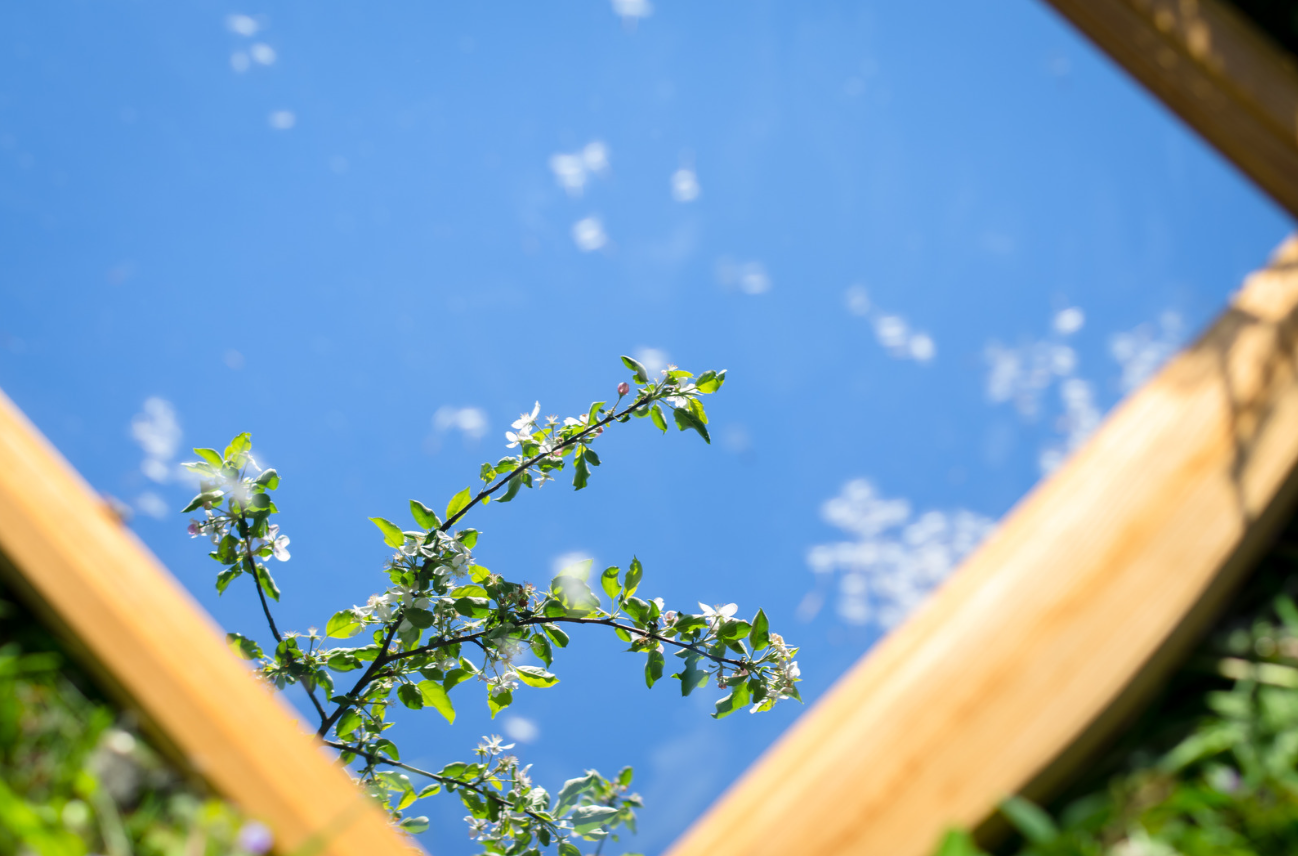
Beyond outdoor street trees, gardens, the sky, water, and maybe our pet companions at home, what else counts as nature in a city? The Urban Nature Identity Study, led by PhD candidate Flora Jiaxuan Xu co-advised by Prof. Sarah Billington and Prof. Nicole Ardoin (ESoS) and in partnership with Gehl, set out to capture exactly these everyday moments of nature in urban life. The central aim is to understand how the simple practice of noticing nature relates to wellbeing and to our sense of what nature is and who we are.
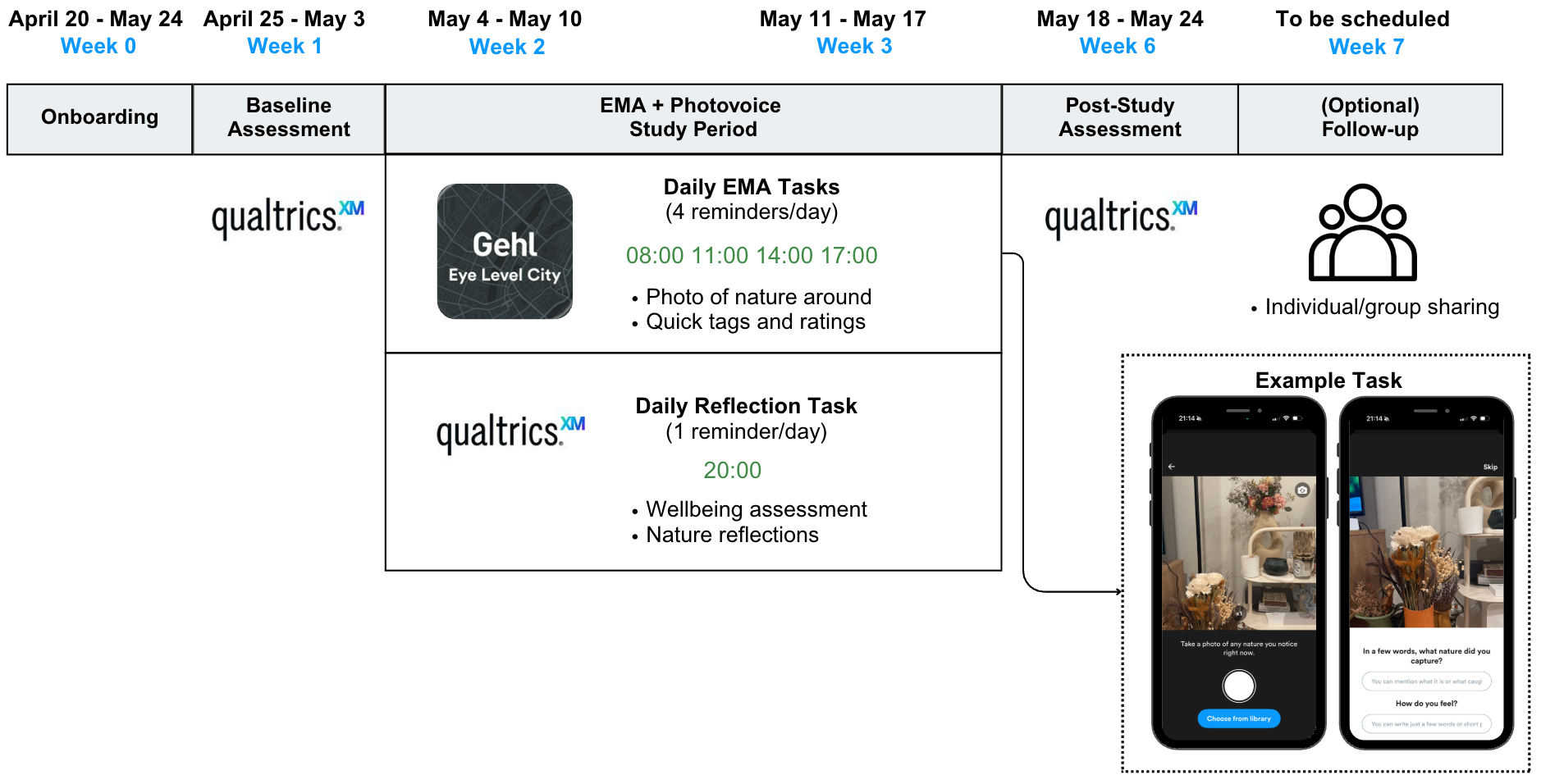
The study uses a mixed-methods approach with surveys, ecological momentary assessment, and photovoice. For 14 days, 91 adults across U.S. cities used the Gehl Eye Level City app to photograph whatever felt like nature in their immediate surroundings, prompted four times a day. Each photo came with a brief reflection and quick tags capturing the emotions and meanings associated with what they noticed. Each evening, participants completed a short check-in on their wellbeing and the most memorable nature moment of their day. Before and after the two weeks, baseline and post-study surveys drew on validated measures of nature connectedness, wellbeing, and personal values, alongside open-ended prompts about how each person defines and relates to nature.
Driving questions
How can directed noticing of everyday urban nature, supported by design and technology, shape what people connect to, how they feel, and how they define nature itself?
Building on the broader Nature Identity framework, this study investigates how noticing can evoke awareness, interpretation, and personal meaning from urban nature encounters, with the aim of reimagining cities as spaces of reconnection rather than separation. Sub-questions include:
What nature do urban residents notice in daily life, and how does it vary across people and contexts?
Does noticing and reflecting on urban nature strengthen connection to nature and wellbeing?
Does sustained noticing broaden how people define what counts as nature?
Project Status
Data collection has now wrapped, yielding a rich corpus of roughly 3,500 photos with associated tags and about 1,200 reflection entries, alongside the daily surveys. As a thank-you, qualifying participants received a curated, personalized Nature Insights Report summarizing their two weeks of noticing and wellbeing trends, capturing just a snapshot of their beautiful journey.
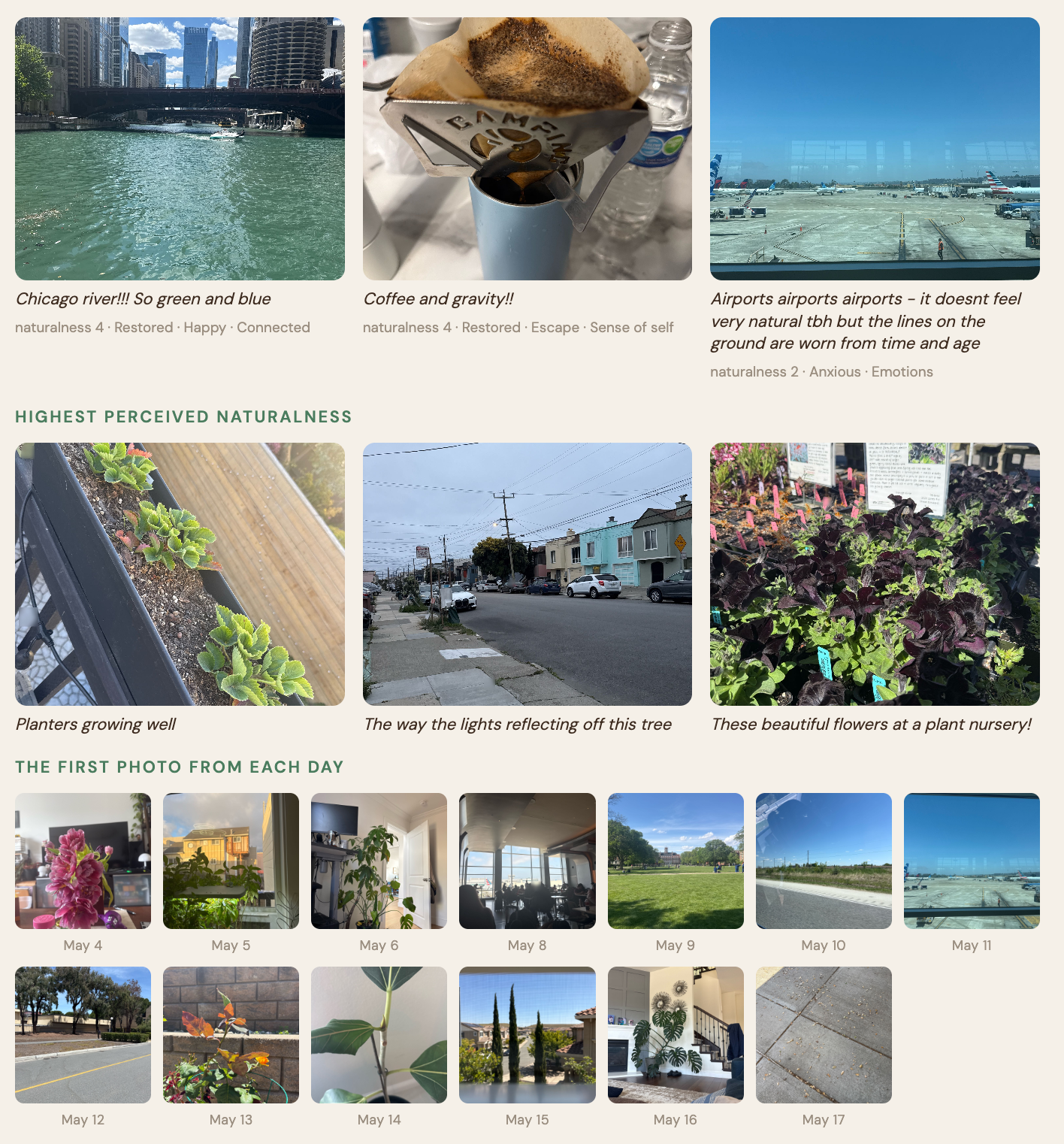
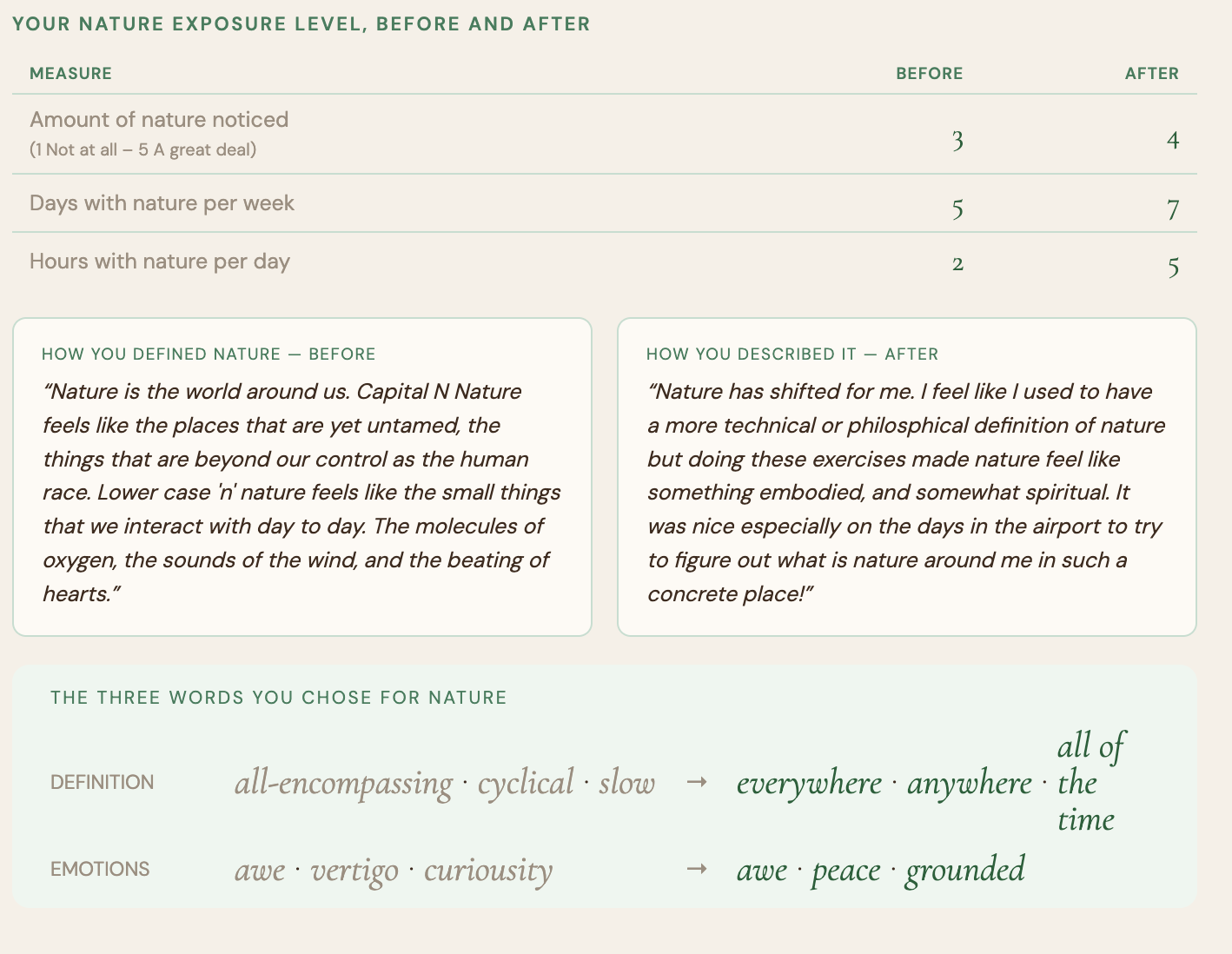
Preliminary analysis suggests that participants' working definitions of nature stretched well beyond default outdoor greenery to include more diverse forms in indoors and in mind, including symbolic and emotional ones. This broadening appeared to go hand in hand with a greater sense of connection to nature and more nature felt in everyday life, alongside reported wellbeing, particularly momentary feelings of awe and mindfulness.
People also differed markedly in what they noticed and the emotions and meanings they attached to it, hinting at the distinct nature identity profiles the study was designed to explore. Early pre-post comparisons point in directions consistent with our hypotheses of increases in mean nature connectedness and wellbeing across the two-week period.
Stay tuned for findings as we explore what these small, everyday moments with nature in urban environments can mean for us and how we can better incorporate relationship-building with nature in urban spaces.
Publications
Analysis in progress - stay tuned!
Project team
This project is in collaboration with the Stanford Social Ecology Lab (SEL) and industry collaborator, Gehl, a global urban strategy and design consultancy. Researchers involved:
Flora Jiaxuan Xu, PhD Candidate, E-IPER Program
Prof. Sarah L. Billington, CEE
Prof. Nicole M. Ardoin (SEL), Environmental Social Sciences
Dr. Alison W. Bowers (SEL), Environmental Social Sciences
Nina Cecilie Højholdt, Gehl